Small-Scale Preservation: Foundational Principles and Three Simple Jar Experiments
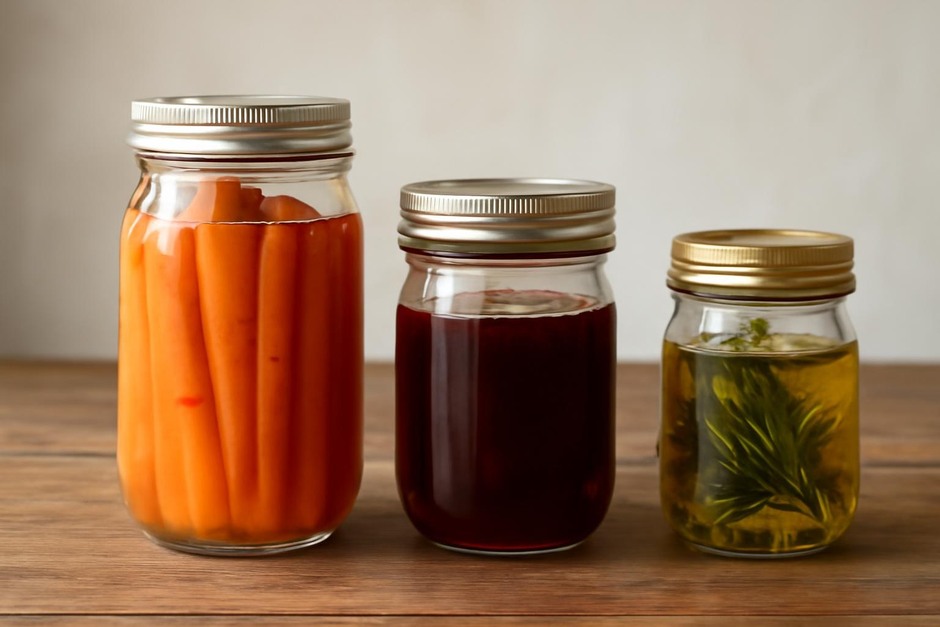
One of the quiet joys of a small harvest is the ability to preserve a single jarful in a way that teaches the craft. Preservation is not only about holding food through a season; it is a compact laboratory for observing how salt, sugar, heat and airflow shape texture and flavor. This article outlines core principles and offers three small experiments you can perform in ordinary jars to connect principle with practice.
Principles: What Preservation Actually Does
At its heart, preservation alters the environment around food so that microbial activity, enzymatic change, and moisture migration proceed at a pace we choose. A few recurring levers appear across methods:
- Moisture control. Drying or adding a solute such as salt or sugar reduces available water and slows spoilage reactions.
- Acidity and anaerobiosis. Increasing acidity (vinegar, lactic fermentation) and reducing oxygen (sealed jars or submerged foods) shift which microorganisms can dominate.
- Temperature and time. Low temperatures slow most biological processes; warmth accelerates fermentation and flavor development.
- Surface contact and infusion. Flavors move predictably across liquid barriers—sugar pulls fruit aromas into syrup; oil extracts aromatic compounds from herbs.
Thinking in these terms helps you choose a method that matches the produce and the result you want: crisper texture, tangy lift, or a syrupy concentrate.
Containers, Seals and Microclimates
A jar is more than a container; it creates a microclimate. Glass is inert and easy to clean, metal lids give a tight seal, and weights or fermenting lids change how oxygen interacts with the food.
- Use clean, undamaged jars. Inspect threads and seals; avoid jars with chips where bacteria can hide.
- Choose the right sealing approach. For fermenting, a loose lid, a breathable cloth, or an airlock let gases escape while limiting oxygen. For syrups and infused oils, sealed lids are appropriate once cooled.
- Label and date. Small-batch projects are experiments; note ratios, temperature and date so you can repeat or tweak.
Experiment 1: Quick Lacto-Fermented Carrots (Single Jar)
This is a tactile way to see lactic acid fermentation produce acidity and preserve crispness.
- Cut 300–400 g carrots into sticks and pack them into a 500 ml jar.
- Make a 2% brine: dissolve 10 g salt in 500 ml water (approximate—precision helps but this ratio is forgiving for a small jar).
- Pour brine to cover carrots, leaving headspace. Use a small weight or folded leaf to keep carrots submerged.
- Cover with a loose lid or cloth and leave at room temperature for 3–7 days, tasting daily for tang. When the tang and texture suit you, move the jar to cool storage.
What to observe: bubbles and a slightly cloudy brine indicate active fermentation. The carrots will slowly turn tangier and remain pleasantly crisp if kept submerged.
Experiment 2: Quick Berry Syrup (Single Jar)
Syrup concentrates fruit flavor and demonstrates how sugar binds water and stabilizes fruit.
- Combine 250 g berries with 125–150 g sugar in a small saucepan.
- Gently heat until sugar dissolves and fruit just releases juices, then simmer briefly to thicken slightly.
- Skim any foam, pour into a warm jar, seal, and cool. Store in the refrigerator and use within a few weeks.
Observe how increasing sugar reduces the free liquid and how gentle heat coaxes aromatic compounds from the fruit without destroying fresh character.
Experiment 3: Gentle Herb-Infused Oil (Jar Infusion)
Infusing oil extracts volatile oils from herbs and creates a flavor medium you can brush on bread or finish a dish with. Use low and dry herbs for safer storage habits.
- Briefly wilt 20–30 g fresh herbs in a dry pan to remove surface moisture, or use fully dried herbs.
- Place herbs in a warm, dry jar and pour in 200–250 ml light olive or neutral oil to cover completely.
- Leave the jar in a warm, sunny spot for a few days, tasting for intensity. Strain into a clean jar, seal and refrigerate; use within a limited time and observe for any off odors or clouding.
Note how oil captures aromatic compounds but not water-soluble flavors. Drying herbs first reduces the risk of moisture-related spoilage.
Conclusion
Small-batch preservation is an invitation to learn by doing. The principles—moisture control, acidity, temperature and contact—apply whether you are fermenting carrots, bathing berries in sugar, or coaxing aromatics into oil. Each jar is a controlled experiment: label it, watch it, and adjust one variable at a time. Over a few simple projects you will develop a sense for how subtle changes in salt, sugar, heat or seal alter texture and flavor—and you’ll return to your pantry with both skill and curiosity.